



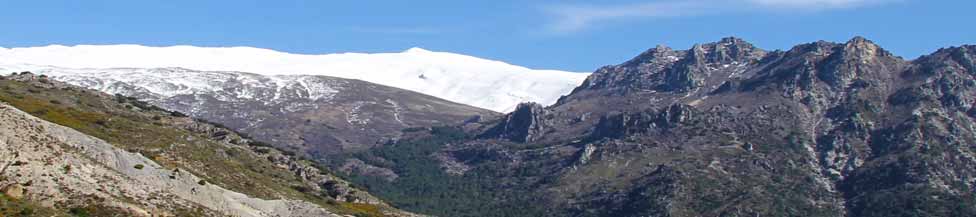
The Iberian Peninsula has a wide geological, tectonic and lithological diversity. Andalusia is located on its southern shores. And, similarly, within the Andalusian Natural Patrimony, the richness and diversity of its geological and geo-diversity patrimony stand out. They result from its geological history and its position between two continents, two oceans and two climatic domains.
The Sierra Nevada Massif is the most important mountainous relief of the Baetic System, a string of folding of the Alpine age located in the South of the Iberian Peninsula. It is a fold, originated by the convergence between the African plate and the Eurasian plate. All the materials that make up Sierra Nevada are metamorphic materials, but of different nature.
The petrological and mineralogical diversity of Andalusia has been one of the most outstanding resources throughout its history. In the different complexes and superimposed units comprising Sierra Nevada, there are sets of rocks and minerals from disparate backgrounds and with a rich geological history.
Structurally, there are three overlapped groups, which are arranged in concentric shape. From the bottom to the top, these are the following:
1. CENTRAL PART
It corresponds to the core of Sierra Nevada, where their higher elevations are. It consists of two tectonically overlapped units. There is one inferior called Veleta and another superior one called Mulhacen.
Composing materials
The metamorphic ancient rocks belonging to the Nevado-Filabride Complex. Schistose materials in brownish hue colours. They present iron mineralization.
2. INTERMEDIATE PART
It is available around the nucleus, skirting the Nevado-Filabride complex and stratigraphically above it.
Composing materials
The materials that compose it are rocks that belong to the geological set called Alpujárride Complex. It is divided into various capes, essentially consisting of a base of slaty material belonging to Filitas (Launa), which present a grey and blue hue and that can acquire the form of shales or argillaceous material. Over it, carbonated materials that correspond to Limestones, Dolomites and Marble can be found.
3. EXTERIOR PART
Outer border.
Composing material
Modern rocks (from the Neogene to Quaternary) varied. The detrital abound. They consist of grains of different morphology. The thick grain detrital (conglomerates and sands) stand out.
GEOMORPHOLOGY
The geomorphology of Sierra Nevada depends on its geological and climate history. The processes of raising and erosion have modelled the relief. It has determined the type of rocks and the geological structure of them. The same has happened with the peculiarities linked to its climate history (glaciers, sandy areas and badlands).