



The construction of the current morphology of Andalusia and its geographical features is the result of a series of paleogeography changes, which are based on the Precambrian and reach our days.
As a part of it, the Alpujarra is a rugged mountainous area with deep valleys and canyons, extending from the southern slopes of Sierra Nevada to the Sierra de Lújar, Sierra de la Contraviesa and the Sierra de Gádor, reaching the Mediterranean Sea. It is divided between the provinces of Granada and Almería, in the south of them. Thus, the Alpujarra of Granada borders in the east with the Alpujarra of Almería. Tablate Bridge is defined as the western end of the Alpujarra.
Structurally, the Alpujarra is a big east and west syncline, forming a big longitudinal valley.
Hydrographically, the region is a very rich area. To the Guadalfeo, Andarax and Grande de Adra rivers, the tributaries like Mecina, Trevélez, Poqueira, Lanjarón, Laroles, Boyárcal, Alcolea or Chico rivers are joined.
The waters of the Sierra Nevada massif are of great quality, both the surface (from snowmelt) and the groundwater. Among the latter, hot and mineralized are included, as the upwelling of Lanjarón. There are also ferruginous waters like Fuente Agria (Pórtugos) or Sonsoles (Pampaneira).
UPPER, MIDDLE AND LOWER ALPUJARRA
Often, there is a division of the region used mainly at the descriptive level, having no relationship with any other kind of consideration.
Upper Alpujarra
It comprises the Southern slopes of Sierra Nevada and the High Andarax. Here are the towns located at an altitude of close to 1,000 meters. The cold weather stands out, as it usually happens in the high mountain.
Towns in the area include, among others, Laujar de Andarax, Pitres, Mecina Bombarón, Yegen, Válor, Canjáyar, Bayárcal or Almócita.
Because of its landscape diversity, the Barranco de Poqueira, Pampaneira, Bubión and Capileira stand out.
Middle Alpujarra
It is represented by the small parallel mountain chain, between Sierra Nevada and the Guadalfeo River. As a result of the longitudinal depression shelter, the climate of the area is not so extreme.
To it, Nieles, Cástaras, Lobras, or populations like Timar belong.
THE MOUNTAINS
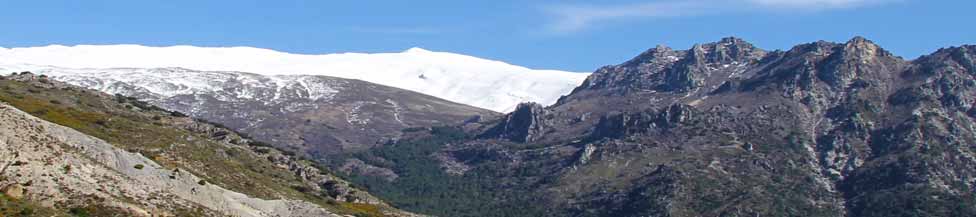
The Alpujarra has a part of its territory in the mountain massif of Sierra Nevada, which is integrated in the Penibaetic system, formed in the Alpine folding. Many of its peaks are located above the 3,000 meters of altitude and it includes the maximum height of the Iberian Peninsula, the Mulhacen, with 3,479 meters, which is followed by the Veleta. The line of peaks of 3,000 metres is covered with snow in the winter. There are several mountain passes, which communicate the Alpujarra with the Marquesado. Because of its isolation and altitude, it is the shelter of numerous endemic plants and animal species.
The glacier lakes of Sierra Nevada make an important set of wetlands of glacier geomorphology. They appear above 2,000 metres, within the territory of the metamorphic schist (slate) and they emerge in the spring, due to melting and they usually disappear in the summer (although some of them are made of permanent water).
The Sierra de la Contraviesa has lower hills. It is parallel to Sierra Nevada and is separated of Sierra Nevada by the Guadalfeo River. The Sierra de Lújar is presented as an independent cross massif. The ensemble is completed with the Sierra de Gádor, which is located in the east. Moreover, inside, there are numerous mountains of minor entity.
THE VALLEYS
The valleys of the Alpujarra stand out for their fertility. The rivers of the region provide them water constantly and, for this reason, its inhabitants have used them to establish a wide network of small crops through history.
The axis of the region is the valley formed by the basins of the rivers Guadalfeo and Andarax, which is structured in a westerly direction.
The southern slopes of the coastal mountains and the eastern part of the region stand out for their aridity.
THE COAST
With more than 120 km of length, the Alpujarra coast is one of the most beautiful and least modified coasts of the Mediterranean Andalusia. Splashed by small coves of transparent waters, it constitutes one of the most prosperous parts of the region because of its greenhouse agriculture and the tourist attraction of its beaches. Locations such as Almerimar, Adra and Castell de Ferro stand out.
WEATHER FEAUTURES
They are determined by the location of the region in the south-east of the peninsula. Its location, parallel to the coast, and the existence of big differences of elevation in relatively short distances are also determining.
Thus, the climate variety ranges from the subtropical climate of the Mediterranean coast, with high temperatures and lack of rain, to the extreme climatic conditions typical of high mountain areas, with more rain and low temperatures.