



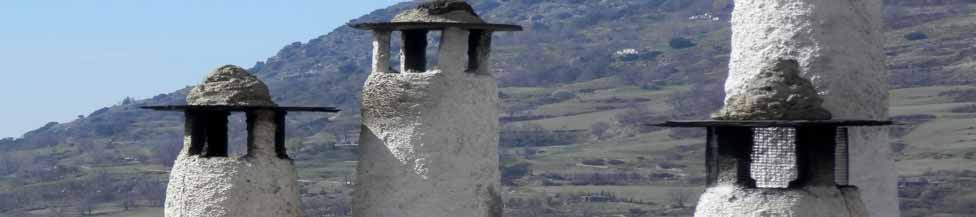
Within the extensive and diverse Agroindustrial Patrimony of the Alpujarra, the buildings, the machinery and the farming tools join the landscapes and the typical activities of the agroindustry.
FARM TOOLS
They are defined as tools normally used by farmers in the different country works. Generally, each of these activities has assigned a kind of specific tool. These can have variables.
| TOOL | USAGE |
| Pliers, Scissors | Harvesting, pruning and cleaning |
| Dibber | Land treatment |
| Plough | Soil cultivation |
| Hoe, mattock | Land treatment |
| Double-tooth hoe | Straw processing |
| Weeding hoe | Land treatment |
| Wooden tub | Transport and storage |
| Scythe | Mowing work |
| Sack | Products transportation |
| Axe | Logging and wood processing |
| Pitchfork | Straw processing |
| Sickle | Mowing |
| Rake | Land processing |
| Pannier | Products transportation |
| Threshing board | Threshing |
Farming implements. Basic typology
CONSTRUCTIONS AND MACHINERY
Mills
When we talk about milling, we refer to an extensive field of study that includes a wide set of machines, gadgets or devices that are moved by traditional energies such as water or wind. There are as many mills as products to be milled.
Oil mills
There are mills from which we obtain mainly olive oil. They can be either individual or collective. In the region, there are about 70 old oil mills.
The transition from the animal-powered oil mill to the water mill may have taken place during the period of Al-Andalus. In the Alpujarra, these maintained the Roman typology of the first mills, based on a fixed stone or path, over which the cylindrical wheel turned around. There are some examples of this in Lújar or Huéchar. Before the electricity, rollers powered first by animals and later mechanically substituted the cylindrical wheels.
In relation to the machinery used in the pressing stage, there are also some examples of this, such as, for example, the traditional beam press.
Water mills
These are installations that use the water energy to be powered. This energy comes from the river flow, streams or canals and it is used in the region to mill cereal mainly. Even though the origin of the water mill goes back to previous periods, it is in the medieval time when its use is widespread. Technological improvements are included and a big typological development is produced.
In relation to its typology, it can be either a vertical or a horizontal water mill. The last one is the most frequent one. It uses some elements that increase the height of the fall of the water and; therefore, it also increases the power or pressure to propel hydraulic wheels. It results in molinos de cubo (tanks) and molinos de rampa (ramps).
To the traditional medieval mills, after some time, some technical innovations have been added. These have concluded with the arrival of electricity. Flourmills represent the end of this, such as the ones of Alhama (Almería) or Laujar (Andarax).
There are some groups of mills in the river Laroles, the ravine of Molinos in Juviles, Berja, Abla and Abrucena. Moreover, there are some mills located in several parts of the region such as in Cádiar, La Tahá, Juviles, Laroles, Pampaneira, Alhama (Almería) and in many other places.
Windmills
These use eolic energy to operate. It is a resource to obtain motive power in the dry zones or in those places far from water streams. The windmill of the region consists of a cylindrical tower structure with a circular base. It is made of masonry, rounded off with lime and it has a conical wooden deck. On one side of the cap, a kind of window is opened and the axis, that holds the blades, can be seen. The milling room is located on the top floor, where the machinery is.
These mills can be found in Darrícal, Félix, Murtas and in the mountains of Gádor, Contraviesa and Lújar.
These were used to mill different cereals, mineral, cork… and even to generate electricity.
Wine Presses
These are spaces where the milling or treading and pressing or crushing of the grape is developed. They have different sizes depending on the extension of the vineyards and they can be settled in houses or country houses.
A typical wine press consists basically of a waterproof flooring with a slight slope, where the grape is treaded prior to the stemming and subsequent pressing. The grape crusher does this process since the 19th century. There are different types of presses, including the beam and the basket press.
Locations: Alboloduy, presses in Albuñol, Albondón, Polopos, Lobras, Cádiar, Ohanes, Mecina Bombarón.
Bread Ovens
The traditional bread ovens, such as the one of Atalbeitar (La Tahá), are known in the region as Moorish ovens. These are vaulted constructions with masonry or brick normally recoated with mud or adobe and put over an uplifted platform. They can be found inside the houses, in the tinaos or directly outside. They can be either individual or collective.
This population has inherited the tradition (of medieval and Roman times) of making bread with flour of different cereals. The art of making bread cooked with firewood is preserved.